What Is Day Trading? A Complete Beginner’s Guide to Strategies, Risks, and Success

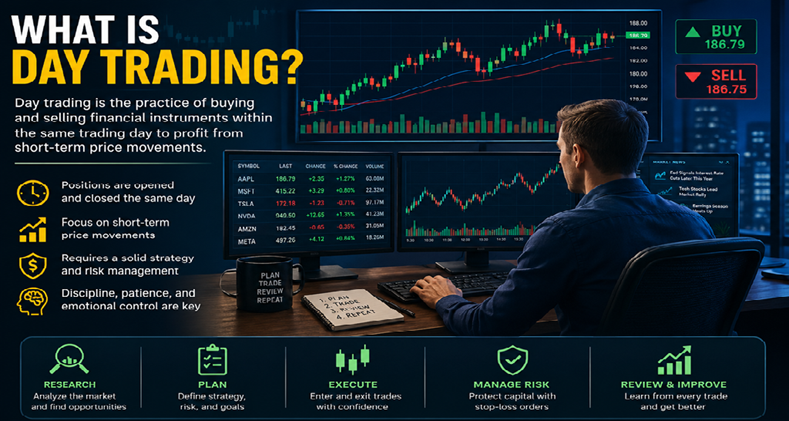
Day trading is a trading strategy that involves buying and selling financial assets within the same trading day. Every position is opened and closed before the market closes, allowing traders to avoid the risks that can come with holding investments overnight.

Unlike long-term investing, which focuses on building wealth over months or years, day trading is centered on short-term price movements. Traders look for opportunities to profit from small changes in price, sometimes holding a position for only a few minutes before moving on to the next trade.

The idea of making money from daily stock market terminology swings appeals to many people. However, day trading is far more demanding than it appears. Success depends on preparation, discipline, market knowledge, and consistent risk management—not luck or quick decisions.

Whether you’re interested in trading stocks, exchange-traded funds (ETFs), options, futures, forex, or cryptocurrencies, understanding the fundamentals is the first step toward becoming a more informed trader.

Why Day Trading Has Gained So Much Popularity

Day trading has become increasingly popular across the United States, especially over the past decade. Technology has made financial markets more accessible than ever, giving individual investors access to tools that were once available only to professional trading firms.

Several factors have contributed to this growth.

Commission-free trading has lowered the cost of entering the market. Modern trading platforms now offer real-time quotes, advanced charting tools, customizable watchlists, and fast order execution from a desktop or mobile device.

Educational content has also expanded dramatically. Online courses, financial podcasts, YouTube channels, webinars, and investing communities have made it easier for beginners to learn the basics of active trading.

Even with these advantages, day trading remains a challenging skill to master. The markets reward preparation, patience, and disciplined execution—not emotion or speculation. Most consistently profitable traders spend years refining their strategies and learning from experience.

How Does Day Trading Work?

The goal of day trading is straightforward: buy an asset at one price and sell it at a higher price—or sell short and buy it back at a lower price—before the trading session ends.

Rather than waiting months for an investment to grow, day traders capitalize on price movements that occur throughout a single trading day.

A Simple Example

Suppose a stock opens at $50 per share after positive news about the company.

A trader believes buying interest will continue during the morning session and purchases 100 shares at $50.

Later that day, the stock climbs to $51.25.

The trader sells all 100 shares before the closing bell.

The trade looks like this:

  • Purchase Price: $5,000
  • Selling Price: $5,125
  • Gross Profit: $125 (before commissions, fees, and taxes)

This example demonstrates the basic concept, but real markets rarely move so smoothly. Prices can reverse unexpectedly, which is why experienced traders place just as much emphasis on limiting losses as they do on finding profitable opportunities.

The Five-Step Day Trading Process

Although every trader develops a personal routine, most successful professionals follow a structured process before placing a trade.

1. Research the Market Before the Opening Bell

Preparation often begins hours before the market opens.

Professional traders review information that could influence prices during the session, including:

  • Corporate earnings reports
  • Economic data releases
  • Federal Reserve announcements
  • Analyst upgrades and downgrades
  • Overnight global market activity
  • Pre-market trading volume
  • Breaking financial news

This research helps identify stocks and other assets that may experience increased volatility and trading activity.

2. Look for High-Probability Trade Setups

Rather than buying or selling based on emotion, disciplined traders wait for opportunities that match their trading plan.

Some of the most common setups include:

  • Breakouts above key resistance levels
  • Pullbacks within an established trend
  • Strong momentum after major news
  • High-volume price moves
  • Technical indicator confirmations

Patience is often one of the biggest advantages experienced traders have over beginners. Waiting for the right opportunity usually produces better results than forcing unnecessary trades.

3. Enter the Trade With a Clear Plan

Before clicking the Buy or Sell button, professional traders already know exactly how the trade will be managed.

Every position should include:

  • A planned entry price
  • A predefined profit target
  • A stop-loss level
  • Appropriate position sizing

Planning each trade in advance removes much of the emotion that can lead to costly mistakes.

4. Manage Risk Throughout the Trade

Finding good opportunities matters, but protecting your trading capital matters even more.

Professional traders focus heavily on risk management because losses are an unavoidable part of trading.

Common techniques include:

  • Setting stop-loss orders before entering a trade
  • Limiting the percentage of capital risked on each position
  • Avoiding oversized trades
  • Following predetermined trading rules
  • Staying disciplined even during losing streaks

Consistent risk management allows traders to recover from setbacks and remain active in the market over the long term.

5. Close Every Position Before the Market Ends

One defining characteristic of day trading is that positions are closed before the trading session ends.

This approach reduces exposure to overnight events that can dramatically affect prices, including:

  • Quarterly earnings announcements
  • Economic reports
  • Interest rate decisions
  • Geopolitical developments
  • Unexpected corporate news

Once a position is held overnight, it generally falls into swing trading or longer-term investing rather than day trading.

What Can You Day Trade?

Although stocks receive the most attention, day traders participate in a variety of financial markets. Each market offers different opportunities, levels of volatility, and risk.

Stocks

Stocks remain the most popular choice for new traders.

Many active traders focus on:

  • Large-cap companies
  • Highly liquid stocks
  • Companies releasing earnings
  • News-driven movers
  • Stocks with unusually high trading volume

High liquidity makes it easier to buy and sell shares quickly while minimizing price slippage.

Exchange-Traded Funds (ETFs)

ETFs provide exposure to a group of securities through a single investment.

Popular ETFs track areas such as:

  • The S&P 500
  • Nasdaq-100
  • Technology
  • Healthcare
  • Energy
  • Small-cap companies

Because ETFs often experience less dramatic price swings than individual stocks, many beginners appreciate their relatively stable trading behavior.

Options

Options allow traders to speculate on future price movements while using less upfront capital than purchasing shares outright.

However, options introduce additional complexities, including:

  • Time decay
  • Implied volatility
  • Strike prices
  • Expiration dates

These factors make options better suited for traders who have a solid understanding of how option contracts work.

Futures

Futures contracts allow traders to speculate on the future value of financial instruments and commodities.

Popular futures markets include:

  • S&P 500 Index
  • Crude oil
  • Gold
  • Natural gas
  • Treasury bonds
  • Agricultural commodities

Because futures frequently involve leverage, even small market moves can produce substantial gains—or losses.

Forex

The foreign exchange market is the world’s largest financial market.

Forex traders buy one currency while simultaneously selling another.

Popular currency pairs include:

  • EUR/USD
  • GBP/USD
  • USD/JPY
  • USD/CAD

The forex market operates nearly 24 hours a day during the business week, making it attractive to traders in different time zones.

Cryptocurrency

Cryptocurrency has become an increasingly active market for short-term traders.

Frequently traded digital assets include:

  • Bitcoin (BTC)
  • Ethereum (ETH)
  • Solana (SOL)
  • XRP

Unlike traditional stock markets, cryptocurrency markets operate 24 hours a day, seven days a week. That constant activity creates more trading opportunities but also introduces significantly higher volatility.

Day Trading vs. Long-Term Investing

Although both approaches involve buying and selling financial assets, they serve very different purposes.

FeatureDay TradingLong-Term Investing
Holding PeriodMinutes to one trading dayMonths to decades
Primary ObjectiveProfit from short-term price movementsBuild long-term wealth
Trading FrequencyMultiple trades in a single dayOccasional buying and holding
Primary AnalysisTechnical analysis and price actionCompany fundamentals and long-term growth
Risk LevelHigherGenerally lower over long investment periods
Time CommitmentSeveral hours each trading dayMinimal day-to-day involvement

Many experienced investors combine these approaches by maintaining a long-term investment portfolio while allocating a separate portion of capital to active trading.

Is Day Trading Right for You?

Day trading isn’t the right fit for everyone. It requires continuous learning, emotional discipline, and the ability to make decisions under pressure.

You may be well suited for day trading if you:

  • Enjoy analyzing charts and market trends.
  • Can follow a written trading plan without emotional decisions.
  • Have time to monitor the markets during trading hours.
  • Understand and accept financial risk.
  • Are committed to improving through education and practice.

If you’re looking for guaranteed income or a fast path to wealth, day trading is unlikely to meet those expectations. Even experienced traders have losing days. Long-term success comes from disciplined execution, effective risk management, and the willingness to keep learning as markets evolve.


Day Trading Strategies Every Beginner Should Know

No single strategy works in every market. Conditions change throughout the trading day, and experienced traders adjust their approach instead of relying on one setup for every situation.

The most successful traders have one habit in common: they follow a tested trading plan. Rather than chasing every price move, they wait patiently for opportunities that meet specific criteria.

Here are some of the most widely used day trading strategies.

1. Momentum Trading

Momentum trading is one of the most popular approaches among active traders.

The goal is simple: identify stocks or other assets experiencing strong buying or selling pressure and trade in the direction of that momentum.

Momentum often develops after events such as:

  • Strong earnings reports
  • Positive company news
  • Analyst upgrades
  • Product launches
  • Unexpected economic data
  • Heavy trading volume

Momentum traders aim to enter early in the move and exit before the trend begins to lose strength.

Example

Imagine a technology company reports earnings that significantly exceed Wall Street expectations.

Before the market opens, its stock is already trading 8% higher in pre-market activity.

Instead of buying immediately, an experienced trader waits for confirmation after the opening bell. If the stock breaks above its morning high with strong volume, the trader enters the position and exits once momentum begins to fade.

Momentum trading can generate impressive returns during strong market conditions, but trends can reverse quickly. That’s why disciplined risk management is essential.

2. Breakout Trading

Breakout trading focuses on price movements beyond established support or resistance levels.

When an asset breaks through one of these key levels with strong volume, it often signals that buyers or sellers have gained control.

Common breakout signals include:

  • Rising trading volume
  • Price closing above resistance
  • Bullish news catalysts
  • Strong overall market sentiment
  • Institutional buying activity

Not every breakout leads to a sustained move. False breakouts occur frequently, so many traders wait for additional confirmation before entering a position.

3. Scalping

Scalping is one of the fastest-paced trading styles.

Rather than holding a position for hours, scalpers look to capture very small price movements multiple times throughout the day.

Individual trades may last only:

  • A few seconds
  • One or two minutes
  • Five to ten minutes

Each trade targets a modest profit, but those gains can add up over dozens of successful trades.

Scalping requires:

  • Quick decision-making
  • Fast order execution
  • High market liquidity
  • Tight bid-ask spreads
  • Exceptional discipline

Because execution speed is critical, scalping is generally better suited for experienced traders.

4. Pullback Trading

Markets rarely move in a straight line.

Even during strong trends, prices often pause or temporarily retrace before continuing in the original direction.

Pullback traders wait for these temporary declines instead of buying after prices have already surged.

This strategy can offer several advantages:

  • Better entry prices
  • Smaller stop-loss distances
  • Improved risk-to-reward opportunities
  • Reduced likelihood of chasing momentum

Patience is one of the biggest strengths of successful pullback traders.

5. Reversal Trading

Reversal trading involves identifying moments when an existing trend appears to be ending.

For example, a stock may decline steadily throughout the morning before signs of buying pressure begin to emerge.

A trader might notice:

  • Increasing trading volume
  • Higher lows forming on the chart
  • Bullish candlestick patterns
  • Momentum indicators turning upward

These signals may suggest that sellers are losing control and buyers are stepping in.

While reversal trading can be rewarding, accurately identifying market turning points is challenging. Many reversals fail before developing into sustained trends.

6. Range Trading

Not every trading day produces strong trends.

Sometimes prices move sideways within a clearly defined range.

Range traders attempt to:

  • Buy near support
  • Sell near resistance

This approach generally works best when:

  • Market volatility is relatively low
  • No major news events are expected
  • Buyers and sellers remain balanced

Once significant news enters the market, established trading ranges can break down quickly.

Essential Technical Indicators for Day Traders

Technical indicators help traders analyze price action and identify potential opportunities.

They work best when combined with sound market analysis and disciplined risk management rather than being used as standalone trading signals.

Moving Averages

Moving averages smooth short-term price fluctuations and help traders identify the broader market trend.

Popular choices include:

  • 9-period Exponential Moving Average (EMA)
  • 20 EMA
  • 50-day Simple Moving Average (SMA)
  • 200-day SMA

Many traders use moving average crossovers or price interactions with these levels to identify potential entry and exit points.

Relative Strength Index (RSI)

The Relative Strength Index measures price momentum on a scale from 0 to 100.

General guidelines include:

  • Above 70: Potentially overbought
  • Below 30: Potentially oversold

RSI works best when used alongside price action, volume, and trend analysis.

Trading Volume

Volume measures how many shares or contracts change hands during a given period.

Strong volume often confirms that a price move has broad market participation.

Many professional traders avoid low-volume stocks because they can produce unreliable price movements and wider spreads.

Volume Weighted Average Price (VWAP)

VWAP represents the average trading price throughout the day while accounting for trading volume.

Institutional investors frequently monitor this indicator.

Many day traders view prices above VWAP as a sign of intraday strength, while prices below VWAP may indicate increasing selling pressure.

MACD (Moving Average Convergence Divergence)

MACD helps traders evaluate both momentum and trend direction.

Common signals include:

  • Bullish crossovers
  • Bearish crossovers
  • Momentum divergence
  • Trend confirmation

Although MACD can be valuable, it generally performs better during trending markets than during sideways conditions.

Bollinger Bands

Bollinger Bands measure market volatility by placing upper and lower bands around a moving average.

As volatility increases, the bands widen.

When volatility declines, they narrow.

Many traders use Bollinger Bands to identify periods when prices appear stretched, but they avoid treating them as automatic buy or sell signals.

Understanding the Most Common Order Types

Choosing the right order type is just as important as choosing the right stock.

Each order serves a different purpose depending on market conditions and your trading strategy.

Market Order

A market order executes immediately at the best available market price.

Best suited for:

  • Fast-moving markets
  • Highly liquid stocks
  • Traders who prioritize execution speed

Potential drawback:

During volatile conditions, the execution price may differ slightly from the quoted price because of slippage.

Limit Order

A limit order allows traders to specify the maximum price they’re willing to pay when buying or the minimum price they’ll accept when selling.

Advantages

  • Greater price control
  • Reduced slippage
  • Better execution planning

Limitation

If the market never reaches your specified price, the order may not be filled.

Stop-Loss Order

A stop-loss order automatically exits a position once the price reaches a predetermined level.

Its primary purpose is protecting trading capital.

Experienced traders rarely enter a position without deciding in advance where they’ll exit if the trade moves against them.

Stop-Limit Order

A stop-limit order combines features of both stop and limit orders.

Once the stop price is triggered, the order becomes a limit order rather than executing immediately.

This provides greater control over execution price but also introduces the possibility that the order won’t be filled during periods of rapid price movement.

Choosing the Right Chart Time Frame

Different strategies require different chart intervals.

Most active traders analyze multiple time frames before entering a trade.

Time FramePrimary PurposeBest For
1-MinuteScalpingExperienced traders
2-MinuteFast momentum tradesActive intraday traders
5-MinuteTrade entriesMost day traders
15-MinuteTrend confirmationIntermediate traders
1-HourOverall market directionPlanning larger intraday moves

Using multiple time frames provides a broader view of market conditions.

For example:

  • Use the 1-hour chart to identify the primary trend.
  • Review the 15-minute chart for support and resistance levels.
  • Execute trades using the 5-minute chart for more precise timing.

This technique, known as multi-timeframe analysis, helps traders avoid making decisions based on a single chart.

Comparing Popular Day Trading Markets

Each financial market offers unique opportunities and challenges.

Choosing the right one depends on your experience, trading style, and tolerance for risk.

MarketVolatilityLiquidityTrading HoursBest For
StocksModerateHighU.S. market hoursMost beginners
ETFsLow to ModerateHighU.S. market hoursConservative active traders
OptionsHighModerateU.S. market hoursExperienced traders
FuturesHighVery HighNearly 24 hoursActive traders seeking leverage
ForexModerateExtremely High24 hours (weekdays)Currency traders
CryptocurrencyVery HighHigh24/7Traders comfortable with significant volatility

Understanding the strengths and risks of each market can help you choose one that aligns with your experience level and financial goals.

Build a Trading Plan Before You Place Your First Trade

A trading plan serves as your roadmap during the trading day.

Without one, decisions are more likely to be driven by emotion rather than logic.

Your plan should clearly answer questions such as:

  • Which markets will I trade?
  • What strategy will I follow?
  • How much will I risk on each trade?
  • Where will I place my stop-loss?
  • What is my daily profit goal?
  • What is my maximum daily loss?
  • Under what conditions will I stop trading for the day?

Having these rules in place before the market opens helps maintain consistency when volatility increases.

Common Mistakes New Day Traders Make

Most beginner mistakes have little to do with market knowledge. Instead, they stem from poor discipline and inconsistent decision-making.

Some of the most common errors include:

  • Trading without a written strategy
  • Ignoring stop-loss orders
  • Risking too much on a single position
  • Chasing stocks after large price moves
  • Overtrading to recover losses
  • Letting emotions dictate decisions
  • Using excessive leverage
  • Failing to review past trades
  • Switching strategies too frequently
  • Expecting immediate success

Every experienced trader has made mistakes. The difference is that successful traders learn from them, refine their process, and continue improving over time instead of repeating the same habits.

Pros and Cons of Day Trading

Day trading offers exciting opportunities, but it also comes with meaningful challenges.

Understanding both sides can help you decide whether it aligns with your financial goals and personality.

ProsCons
Opportunity to profit from short-term market movesHigh financial risk
No overnight exposure to market eventsEmotionally demanding
Flexible work environmentRequires extensive practice
Access to multiple financial marketsLosses can accumulate quickly
Immediate performance feedbackTime-intensive
Constant learning opportunitiesStrong discipline is essential
Can be combined with long-term investingTechnology issues can interrupt trading

Approach day trading with realistic expectations. Treating it as a professional skill—not a shortcut to wealth—can help you develop better habits over time.

Expert Tips for Long-Term Trading Success

Consistent traders focus on building good habits rather than chasing quick profits.

These practices can help improve your decision-making over time:

  • Practice with a paper trading account before risking real money.
  • Master one trading strategy before experimenting with others.
  • Focus on liquid markets with strong trading volume.
  • Define your entry, exit, and stop-loss before every trade.
  • Never increase position size to recover previous losses.
  • Review your trades weekly to identify recurring strengths and weaknesses.
  • Stay informed about earnings reports and major economic events.
  • Continue learning through reputable books, courses, and market research.
  • Protect your capital first. Opportunities will always come, but lost capital is much harder to replace.

Successful trading isn’t measured by one profitable day. It’s built through disciplined execution, continuous learning, and sound risk management over months and years.

(FAQs)

1. What is day trading in simple terms?

Day trading is the practice of buying and selling financial assets within the same trading day. Traders close every position before the market closes, aiming to profit from short-term price movements while avoiding overnight market risk.

2. Is day trading profitable?

Day trading can be profitable, but success is far from guaranteed. Consistently profitable traders typically rely on a well-tested strategy, disciplined risk management, and years of practice. Many beginners lose money because they trade emotionally or without a clear plan.

3. How much money do I need to start day trading?

The amount depends on the market you trade and your broker’s requirements. In the United States, traders using a margin account who qualify as Pattern Day Traders generally must maintain at least $25,000 in account equity. Cash accounts and other markets may follow different rules.

4. Is day trading legal in the United States?

Yes. Day trading is legal when conducted through a regulated brokerage firm and in accordance with U.S. securities laws and brokerage requirements.

5. What’s the difference between day trading and swing trading?

The biggest difference is the holding period.

  • Day traders open and close positions within the same trading day.
  • Swing traders hold positions for several days or weeks to capture larger price movements.

Both strategies require research and risk management, but they differ in time commitment and trading style.

6. Which market is best for beginners?

Many new traders start with highly liquid U.S. stocks or broad-market ETFs because they generally offer tighter spreads and consistent trading volume. The best market ultimately depends on your goals, available capital, and comfort with risk.

7. Can I day trade while working a full-time job?

Yes, but it can be challenging. Some traders focus on the first hour after the U.S. market opens, when trading activity is often highest. Others trade markets with extended hours, such as forex or cryptocurrency.

8. What are the biggest risks of day trading?

The most significant risks include:

  • Sudden market volatility
  • Emotional decision-making
  • Excessive leverage
  • Poor risk management
  • Unexpected news events
  • Technology or internet failures

Understanding these risks is just as important as learning trading strategies.

9. Do I need technical analysis to day trade?

Most day traders rely on technical analysis because short-term price movements are often driven by market sentiment, momentum, and trading volume. Learning to read charts and recognize common patterns can improve decision-making, but technical analysis should always be paired with sound risk management.

10. Can beginners become successful day traders?

Yes, but success usually comes through education, practice, and patience rather than quick profits. Starting with paper trading, keeping a detailed trading journal, and following a structured trading plan can help beginners build confidence before risking real money.

Final Thoughts

Day trading offers an exciting way to participate in the financial markets, but it demands far more than quick reactions and market intuition. Long-term success comes from understanding how markets behave, managing risk carefully, and following a disciplined process every time you trade.

If you’re just beginning your trading journey, resist the temptation to focus solely on potential profits. Instead, invest time in learning market fundamentals, studying price action, practicing with a paper trading account, and developing a strategy you can follow consistently. Those habits will serve you far better than chasing the latest trading trend or social media tip.

Remember that even professional traders experience losses. What separates them from the crowd is their ability to manage those setbacks without abandoning their plan. They think in probabilities, protect their capital, and continue refining their skills over time.

Leave a Comment