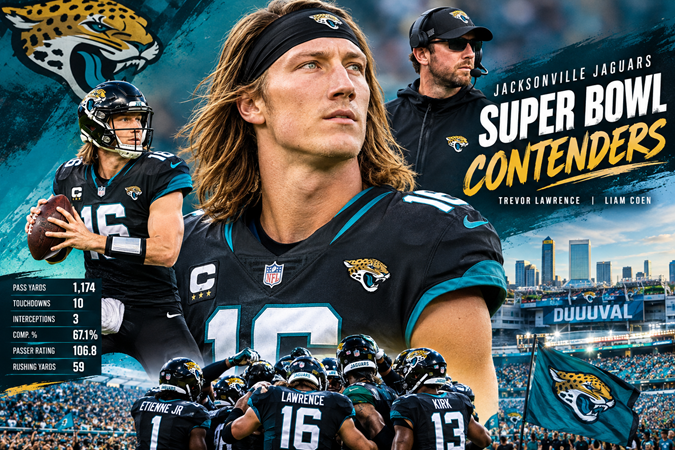

Through five games of the 2026 NFL season, Trevor Lawrence is delivering on the promise that made him the first overall draft pick in 2021. More importantly, his development under Liam Coen has transformed the Jacksonville Jaguars from an improving playoff team into credible Super Bowl contenders.
The Jaguars entered Week 6 with a 4-1 record and control of the AFC South. Lawrence had completed 96 of 143 passes for 1,174 yards, 10 touchdowns and only three interceptions. His 67.1% completion rate, 8.2 yards per attempt and 106.8 passer rating all demonstrate how efficiently he has directed the offense. He had also contributed 59 rushing yards, giving Jacksonville an additional option when plays break down.
Those numbers reflect a quarterback playing with greater command, rather than simply benefiting from favourable circumstances. Lawrence is processing defensive coverages more quickly, attacking opportunities downfield and limiting the costly mistakes that affected his earlier seasons.
Building on a Breakthrough Year
Lawrence’s current form is an extension of his outstanding 2025 campaign. In his first season with Coen, he passed for 4,007 yards and 29 touchdowns while adding nine rushing scores. His franchise-record total of 38 touchdowns helped the Jaguars finish 13-4 and win the AFC South, while also earning him fifth place in Associated Press MVP voting.
Jacksonville’s season ended with a home defeat to the Buffalo Bills in the wild-card round, but the campaign changed expectations around the franchise. It also established a foundation that Lawrence and Coen have strengthened in 2026.
The early results have inevitably affected discussions on DraftKings surrounding NFL odds, with the Jaguars increasingly viewed as a team capable of progressing deep into January. Their argument is supported by more than their record: Jacksonville is scoring 24.6 points per game and conceding only 14, the second-lowest figure in the league through five games.
Lawrence Is Winning in Different Ways
The opening victory against the Cleveland Browns offered the clearest example of Lawrence’s ceiling. He completed 18 of 23 passes for 245 yards and four touchdowns, finishing with a near-perfect 150.6 passer rating as Jacksonville won 34-10.
After a difficult defeat in Denver, he responded with three touchdown passes in a 35-6 victory over the New England Patriots. Lawrence then completed 78.3% of his throws against the Cincinnati Bengals, producing 227 yards, one touchdown and no interceptions in a 22-17 road win.
His performance against the Philadelphia Eagles demonstrated another side of his development. Lawrence attempted a season-high 39 passes and finished with 331 yards, two touchdowns and one interception in a 19-17 victory. It was not his most efficient game, but he continued creating plays and delivering in a close contest against dangerous opposition.
That adaptability matters in the postseason. Super Bowl quarterbacks must win high-scoring contests, manage difficult road games and respond when the original offensive plan stops working. Lawrence is increasingly showing that complete range.
How Liam Coen Unlocked the Offense
Coen’s arrival in 2025 provided Lawrence with an offensive structure built around movement, play action and flexible answers against changing defensive looks. There were early growing pains, but the Jaguars averaged 32.8 points after their 2025 bye, the league’s second-best figure over that stretch. They subsequently closed the regular season with eight consecutive victories.
The most important change has been Lawrence’s ownership of the system. Coen has explained that his quarterback progressed from simply executing formations and motions to changing plays at the line of scrimmage. By the end of 2025, Lawrence was abandoning called plays entirely in favour of audibles he recognised as better answers to the defence.
That understanding has carried into Coen’s second season. The coach can now install more detailed concepts without asking Lawrence to learn an entirely unfamiliar language. Lawrence, meanwhile, can concentrate on manipulating defenders and finding favourable matchups.
A More Complete Supporting Cast
Jacksonville’s improvement is not a one-man story. Running back Bhayshul Tuten had produced 349 rushing yards through five games, while receiver Parker Washington led the team with 352 receiving yards and four touchdowns. Tight end Brenton Strange had contributed 235 yards, and Jakobi Meyers had added 202 yards with two scores.
This distribution makes the Jaguars difficult to defend. Opponents cannot concentrate exclusively on one star receiver, while the running game prevents defences from treating every snap as an obvious passing situation.
The defence has also supplied the balance required of a championship team. Jacksonville’s ability to restrict opponents to 14 points per game means Lawrence does not have to produce four touchdowns every week.
Why Jacksonville Can Reach the Super Bowl
It remains early in the season, and five games cannot guarantee postseason success. The Jaguars must keep Lawrence healthy, improve protection consistency and prove they can maintain their defensive standard against the AFC’s strongest opponents.
Nevertheless, the essential ingredients are present: an elite-level quarterback, a creative head coach, a balanced supporting cast and a defence capable of controlling games. Lawrence and Coen have already taken Jacksonville from a rebuilding project to a division champion. Their second year together now looks capable of producing something greater.
For the first time in years, reaching the Super Bowl does not feel like an unrealistic ambition in Jacksonville. It feels like the logical objective for a team whose quarterback has finally become the commanding, decisive leader it always believed he could be.