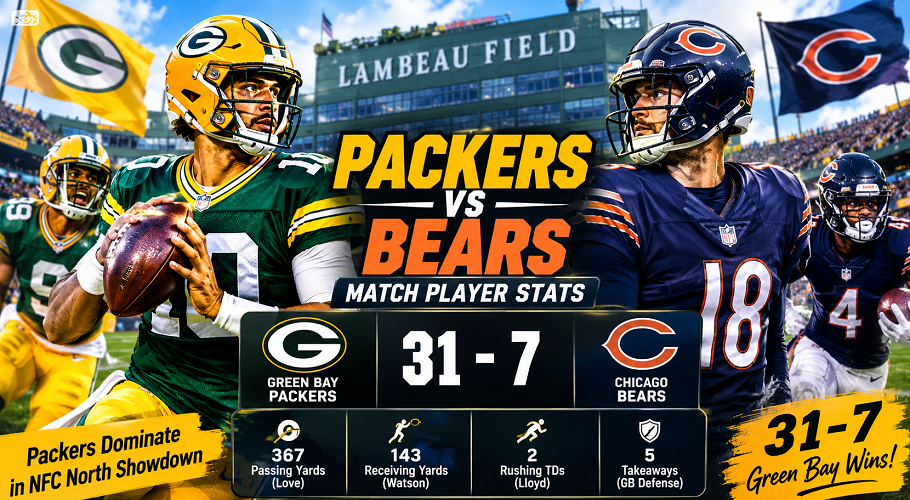

Few rivalries in professional football carry the history and intensity of the Green Bay Packers vs Chicago Bears match player stats. Every meeting brings another chapter to one of the NFL’s most recognisable rivalries.
Their October 11, 2026, matchup at Lambeau Field gave Green Bay plenty to celebrate. The Packers defeated Chicago 31-7, delivering an impressive performance on both sides of the football.
Quarterback Jordan Love led the offence with 367 passing yards and two touchdowns. Wide receiver Christian Watson became his favourite deep-threat target, finishing with 143 receiving yards and two scores.
The Packers’ defence also played a decisive role. It forced five turnovers, including three interceptions, while keeping Chicago out of the end zone after halftime.
The Bears struggled to establish a consistent passing attack. Their quarterbacks combined for 195 passing yards, three interceptions, and no passing touchdowns.
This breakdown of the Green Bay Packers vs Chicago Bears match player stats covers the complete offensive performances, individual leaders, team comparisons, and defensive highlights.
Whether you’re following the NFC North, researching player performances, or checking fantasy football numbers, here’s what the statistics reveal about this divisional matchup.
Also Read: Trevor Lawrence’s Rise Has Turned the Jacksonville Jaguars into Super Bowl Contenders
Green Bay Packers vs Chicago Bears: Match Overview
The Packers hosted the Bears on Sunday, October 11, 2026, at Lambeau Field in Green Bay, Wisconsin.
Chicago entered the contest hoping to challenge its long-time rival. However, Green Bay controlled the game after halftime and secured a comfortable victory.
Final Score
| Team | 1st Quarter | 2nd Quarter | 3rd Quarter | 4th Quarter | Final |
|---|---|---|---|---|---|
| Chicago Bears | 0 | 7 | 0 | 0 | 7 |
| Green Bay Packers | 7 | 7 | 9 | 8 | 31 |
The Packers established an early advantage with two touchdowns. Chicago responded with a second-quarter rushing score from D’Andre Swift, making it a 14-7 game at halftime.
Green Bay then took control.
Christian Watson caught a 53-yard touchdown pass in the third quarter. MarShawn Lloyd added another rushing touchdown in the fourth, and the Packers finished with a 24-point victory.
Game information:
- Matchup: Chicago Bears vs. Green Bay Packers
- Date: October 11, 2026
- Competition: NFL Regular Season
- Week: Week 5
- Stadium: Lambeau Field
- Location: Green Bay, Wisconsin
- Final Score: Green Bay 31, Chicago 7
- Winning Team: Green Bay Packers
Green Bay Packers vs Chicago Bears Match Player Stats
The individual numbers explain how Green Bay created such a significant advantage.
Jordan Love delivered an efficient passing performance, while the Packers’ receivers consistently found opportunities downfield.
Chicago had some productive individual moments, but turnovers and limited passing production prevented the team from keeping pace.
1. Green Bay Packers Player Stats
Green Bay finished with 428 total net yards. Its passing attack accounted for most of that production.
Here’s a closer look at the Packers’ leading offensive performers.
Passing Statistics
| Player | Completions/Attempts | Passing Yards | TD | INT |
|---|---|---|---|---|
| Jordan Love | 25/31 | 367 | 2 | 0 |
Jordan Love was the driving force behind Green Bay’s offensive success.
He completed 25 of 31 attempts, giving him an impressive 80.6% completion rate. His 367 passing yards included two touchdown passes to Christian Watson.
Love also avoided interceptions, allowing the Packers to maintain possession and pressure Chicago’s defense.
His 137.5 passer rating reflected an outstanding individual performance.
The most impressive part was his ability to attack downfield. Rather than relying exclusively on short completions, Love repeatedly found opportunities to stretch the Bears’ secondary.
Rushing Statistics
| Player | Carries | Rushing Yards | Longest Run | TD |
|---|---|---|---|---|
| MarShawn Lloyd | 10 | 31 | 10 | 2 |
| Kaleb Johnson | 7 | 26 | 23 | 0 |
| Pierre Strong Jr. | 5 | 7 | 5 | 0 |
| Jordan Love | 1 | 6 | 6 | 0 |
| Tucker Kraft | 1 | 2 | 2 | 0 |
| Tyrod Taylor | 2 | -2 | -1 | 0 |
MarShawn Lloyd made his opportunities count.
He recorded 31 yards on 10 carries and scored twice. Both touchdowns helped Green Bay maintain control of the scoreboard.
Kaleb Johnson provided another useful rushing contribution. He finished with 26 yards, including a 23-yard run.
Green Bay’s ground game produced 70 rushing yards overall. Although that total wasn’t particularly explosive, the team found the end zone when it mattered.
Receiving Statistics
| Player | Receptions | Receiving Yards | Longest Catch | TD |
|---|---|---|---|---|
| Christian Watson | 6 | 143 | 53 | 2 |
| Matthew Golden | 6 | 123 | 50 | 0 |
| Tucker Kraft | 5 | 64 | 46 | 0 |
| Bo Melton | 3 | 20 | 8 | 0 |
| Pierre Strong Jr. | 3 | 11 | 8 | 0 |
| MarShawn Lloyd | 1 | 6 | 6 | 0 |
| Skyy Moore | 1 | 0 | 0 | 0 |
Christian Watson delivered the standout receiving performance.
He caught six passes for 143 yards and two touchdowns. His longest reception covered 53 yards and demonstrated his ability to create separation downfield.
Matthew Golden was equally valuable as a secondary receiving option. He also caught six passes, producing 123 yards.
Together, Watson and Golden accounted for 266 receiving yards.
That combination gave Jordan Love multiple ways to attack Chicago’s coverage. It also prevented the Bears from focusing their defensive attention on a single receiver.
Tucker Kraft added five receptions for 64 yards. His contribution helped keep the passing offence balanced.
2. Chicago Bears Player Stats
Chicago finished with 246 total net yards, considerably fewer than Green Bay.
The Bears struggled to establish a consistent passing rhythm. Their quarterback rotation also produced three interceptions, creating additional problems for the offence.
Nevertheless, several players contributed respectable individual numbers.
Passing Statistics
| Player | Completions/Attempts | Passing Yards | TD | INT |
|---|---|---|---|---|
| Case Keenum | 11/19 | 108 | 0 | 1 |
| Tyson Bagent | 12/21 | 87 | 0 | 2 |
Case Keenum finished with 108 passing yards and one interception.
Tyson Bagent completed 12 of 21 passes for 87 yards. He also threw two interceptions.
Neither quarterback recorded a passing touchdown.
The combined production fell well short of what Chicago needed against Green Bay’s defence.
The interceptions were particularly damaging. They interrupted promising possessions and gave the Packers additional opportunities to extend their lead.
Chicago needed better quarterback decision-making and more consistent execution to remain competitive.
Rushing Statistics
| Player | Carries | Rushing Yards | Longest Run | TD |
|---|---|---|---|---|
| D’Andre Swift | 9 | 43 | 12 | 1 |
| Tyson Bagent | 3 | 17 | 7 | 0 |
| Zavion Thomas | 1 | 11 | 11 | 0 |
| Roschon Johnson | 5 | 6 | 3 | 0 |
| Case Keenum | 1 | 4 | 4 | 0 |
| Luther Burden III | 4 | 2 | 7 | 0 |
| Kalif Raymond | 1 | -2 | -2 | 0 |
D’Andre Swift led Chicago’s rushing attack with 43 yards on nine carries.
He also scored the Bears’ only touchdown, reaching the end zone on a one-yard run during the second quarter.
Tyson Bagent contributed 17 rushing yards. Zavion Thomas added 11 yards on his only attempt.
However, the Bears couldn’t consistently move the football on the ground. Their 81 rushing yards offered limited support for an already struggling passing offence.
Receiving Statistics
| Player | Receptions | Receiving Yards | Longest Catch | TD |
|---|---|---|---|---|
| Luther Burden III | 4 | 47 | 23 | 0 |
| Rome Odunze | 3 | 40 | 20 | 0 |
| Roschon Johnson | 5 | 34 | 9 | 0 |
| D’Andre Swift | 4 | 30 | 13 | 0 |
| Colston Loveland | 2 | 19 | 12 | 0 |
| Zavion Thomas | 1 | 11 | 11 | 0 |
| Cole Kmet | 1 | 8 | 8 | 0 |
| Kalif Raymond | 3 | 6 | 6 | 0 |
Luther Burden III led Chicago’s receivers with 47 yards on four catches.
Rome Odunze followed with 40 yards, while Roschon Johnson contributed 34 yards on five receptions.
D’Andre Swift added another 30 receiving yards.
Despite these individual contributions, Chicago couldn’t produce a receiving touchdown. The lack of explosive passing plays made it difficult to challenge Green Bay’s defensive coverage.
Packers vs Bears: Complete Team Statistics Comparison
Individual performances tell only part of the story. Team statistics provide a clearer picture of how Green Bay controlled the matchup.
| Statistical Category | Packers | Bears |
|---|---|---|
| Final Score | 31 | 7 |
| Total Net Yards | 428 | 246 |
| Passing Yards | 358 net | 165 net |
| Passing Completions | 25 | 23 |
| Passing Attempts | 31 | 40 |
| Rushing Yards | 70 | 81 |
| Total Turnovers | 0 | 5 |
| Penalties | 4 | 3 |
| Penalty Yards | 25 | 20 |
| Time of Possession | 30:24 | 29:36 |
| Total Plays | 59 | 68 |
| Yards Per Play | 7.3 | 3.6 |
Team passing-yard figures represent net passing yards after sack adjustments. Individual passing totals are shown separately.
What the Team Numbers Reveal
Three areas explain much of the difference between these teams.
1. Green Bay controlled the passing game.
The Packers completed 25 of 31 passes for 367 individual passing yards. Chicago’s quarterbacks combined for 195 yards on 40 attempts.
Green Bay also produced more yards per play, averaging 7.3 compared with Chicago’s 3.6.
2. Turnovers created a major disadvantage for Chicago.
The Bears committed five turnovers, while Green Bay finished without one.
Those mistakes gave the Packers additional opportunities and repeatedly disrupted Chicago’s offensive rhythm.
3. Green Bay converted opportunities into points.
The Packers scored 31 points, including 17 after halftime. Chicago failed to score in either of the final two quarters.
The second-half performance demonstrated Green Bay’s ability to maintain pressure rather than simply protect an early lead.
Key Players Who Shaped the Packers vs Bears Game: Green Bay Packers vs Bears Match Player Stats
Several individual performances deserve additional attention.
Jordan Love: The Difference-Maker at Quarterback
Jordan Love controlled the game with accurate passing and excellent downfield execution.
His 367 passing yards represented a major offensive advantage. He also completed 80.6% of his attempts without throwing an interception.
Love consistently found open receivers and made Chicago pay for defensive mistakes.
Christian Watson: Green Bay’s Biggest Receiving Threat
Watson delivered the most productive receiving performance of the afternoon.
His 143 yards and two touchdowns helped establish Green Bay’s offensive dominance.
Both touchdown receptions demonstrated his ability to create big plays against Chicago’s secondary.
Matthew Golden: A Valuable Offensive Weapon
Matthew Golden finished with 123 receiving yards and six catches.
His 50-yard reception added another explosive element to the Packers’ passing game.
Golden’s performance also made defensive adjustments more difficult for Chicago.
MarShawn Lloyd: Two Important Rushing Touchdowns
Lloyd didn’t need a huge rushing total to make an impact.
His 31 yards and two touchdowns helped Green Bay maintain its scoring advantage.
His ability to finish drives gave the Packers another offensive option beyond the passing game.
D’Andre Swift: Chicago’s Leading Rusher
Swift was one of Chicago’s more productive offensive players.
He recorded 43 rushing yards and scored the team’s only touchdown.
His performance offered some encouragement, although the Bears needed considerably more production from their passing attack.
How the Packers Defense Changed the Game
Green Bay’s offensive production attracted plenty of attention, but the defense played an equally important role.
The Packers forced five turnovers and repeatedly stopped Chicago from building momentum.
Their defensive performance included three interceptions and two lost fumbles by Chicago.
Xavier McKinney recorded two interceptions, while Ty’Ron Hopper added another. Devonte Wyatt contributed a strip-sack, and Zaire Franklin forced a fumble.
These plays changed the game’s momentum and gave Green Bay control of the contest.
Defensive Highlights
- Five takeaways forced by Green Bay.
- Three interceptions against Chicago.
- Two interceptions recorded by Xavier McKinney.
- One interception recorded by Ty’Ron Hopper.
- A strip-sack contribution from Devonte Wyatt.
- A forced fumble from Zaire Franklin.
- Zero interceptions thrown by Jordan Love.
Chicago’s mistakes became particularly costly after halftime. The Bears turned the ball over on four consecutive second-half possessions.
That defensive pressure prevented any realistic comeback.
Packers vs Bears Performance: Pros and Cons
Looking beyond the final score reveals what each team did well and where it struggled.
Green Bay Packers
Pros
- Jordan Love completed 80.6% of his passes.
- The offense produced 428 total net yards.
- Christian Watson recorded 143 receiving yards and two touchdowns.
- Matthew Golden added 123 receiving yards.
- MarShawn Lloyd scored twice.
- The defense forced five turnovers.
- Green Bay protected the football throughout the game.
Cons
- The rushing attack produced only 70 yards.
- The offense averaged 2.7 yards per rushing attempt.
- The running game lacked the same explosiveness as the passing attack.
- The team could still improve its consistency on the ground.
Chicago Bears
Pros
- D’Andre Swift recorded 43 rushing yards.
- Luther Burden III led the team in receiving yards.
- The rushing attack produced 81 total yards.
- Chicago committed only three penalties.
- The team maintained possession for almost half the game.
Cons
- The quarterbacks combined for three interceptions.
- Chicago committed five turnovers overall.
- The offense failed to record a passing touchdown.
- The defense allowed 428 total net yards.
- The Bears struggled to create explosive offensive plays.
- Chicago failed to score after halftime.
Expert Tips: How to Understand NFL Player Statistics
An NFL box score contains more useful information than passing yards and touchdowns alone.
Understanding several key measurements can help readers evaluate individual performances more accurately.
1. Look Beyond Passing Yards
Passing yards provide a useful starting point, but they don’t tell the complete story.
Check completion percentage, touchdowns, interceptions, and passer rating.
Jordan Love’s 367 yards become even more impressive when combined with his 80.6% completion rate and zero interceptions.
2. Compare Receiving Efficiency
Receptions and receiving yards help identify a team’s most productive targets.
However, longest reception and yards per catch also matter.
Watson averaged approximately 23.8 yards per reception. That figure highlights his impact as a downfield threat.
3. Pay Attention to Turnover Differential
Turnover differential measures the difference between takeaways and giveaways.
Green Bay finished with a five-turnover advantage in this matchup.
That difference can explain why one team controls the game despite similar possession numbers.
4. Evaluate Rushing Production
Rushing attempts, yards per carry, and touchdowns provide a better picture of a running back’s contribution.
For example, Swift recorded 43 yards on nine attempts. Lloyd produced 31 yards and two touchdowns on 10 carries.
Both players contributed, but their impact came in different ways.
5. Use Reliable Sources for Official Numbers
NFL statistics can change following official scoring reviews.
For accurate information, compare game reports and box scores from established sources.
The NFL, official team websites, and recognized sports publications are useful places to start.
(FAQs): Green Bay Packers vs Bears Match Player Stats
1. Who won the Green Bay Packers vs Chicago Bears game in October 2026?
The Green Bay Packers defeated the Chicago Bears 31-7 on October 11, 2026. The game took place at Lambeau Field in Green Bay, Wisconsin.
2. How many passing yards did Jordan Love record against the Bears?
Jordan Love recorded 367 passing yards. He completed 25 of 31 attempts, threw two touchdowns, and finished without an interception.
3. How many receiving yards did Christian Watson have?
Christian Watson recorded 143 receiving yards on six receptions. He also caught two touchdown passes from Jordan Love.
4. Who led the Bears in rushing yards?
D’Andre Swift led Chicago’s rushing attack with 43 yards on nine carries. He also scored the Bears’ only touchdown.
5. How many touchdowns did MarShawn Lloyd score?
MarShawn Lloyd scored two rushing touchdowns against Chicago. He finished with 31 yards on 10 carries.
6. How many interceptions did the Bears throw?
Chicago’s quarterbacks combined for three interceptions. Tyson Bagent threw two, while Case Keenum threw one.
7. Which team recorded more total yards?
Green Bay recorded 428 total net yards, compared with Chicago’s 246. The Packers held a 182-yard advantage.
8. Who was the leading receiver in the game?
Christian Watson led all receivers with 143 yards and two touchdowns. Matthew Golden ranked second with 123 receiving yards.
9. How many turnovers did the Packers force?
Green Bay forced five turnovers, including three interceptions and two lost fumbles. The defense played a major role in the 31-7 victory.
10. When is the next Packers vs Bears game scheduled?
The next regular-season meeting is scheduled for December 25, 2026, at Soldier Field in Chicago. The Christmas Day matchup gives both NFC North rivals another opportunity to compete.
Conclusion: Green Bay Packers vs Bears Match Player Stats
The Green Bay Packers vs Chicago Bears match player stats highlight a convincing performance from Green Bay.
Jordan Love led the offense with 367 passing yards and two touchdowns. Christian Watson delivered 143 receiving yards, while Matthew Golden added another 123.
MarShawn Lloyd contributed two rushing touchdowns, giving the Packers another scoring option. On defense, Green Bay forced five turnovers and kept Chicago from scoring in the second half.
The Bears had some positive individual performances, particularly from D’Andre Swift. However, three quarterback interceptions and two lost fumbles made the challenge too difficult.
Ultimately, Green Bay’s passing efficiency, explosive receiving plays, and defensive pressure decided the matchup.
For fans following this historic NFC North rivalry, the box score offers a useful look at the strengths and weaknesses of both teams. These individual performances also provide important context for evaluating their progress throughout the 2026 NFL season.