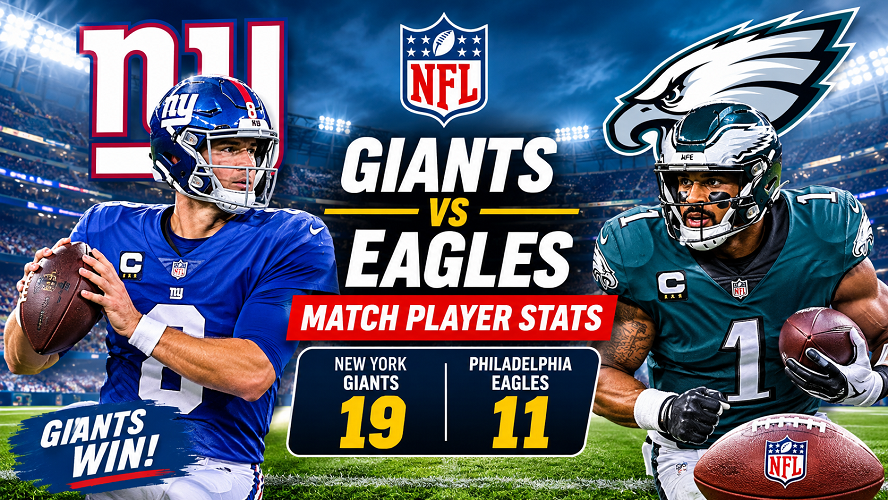

The New York Giants and Philadelphia Eagles renewed their NFC East rivalry on November 8, 2026. This Week 9 matchup at Lincoln Financial Field produced an unexpected result, with the Giants earning a 19–11 road victory. New York Giants vs Philadelphia Eagles Match Player Stats. New York relied on defensive pressure, controlled possession, and timely offensive execution. Philadelphia, meanwhile, struggled to turn its offensive production into points.
Joe Milton threw for 169 yards and added 64 rushing yards. However, the Eagles managed just one touchdown throughout the contest.
For Giants and Eagles fans, the individual performances tell an interesting story. The New York Giants vs Philadelphia Eagles match player stats reveal how quarterback contributions, rushing efficiency, receiving production, and defensive pressure shaped the result.
This breakdown examines the game’s major performances, team statistics, scoring sequence, and the moments that ultimately decided the matchup.
Also Read: Texans vs Kansas City Chiefs Match Player Stats
New York Giants vs Philadelphia Eagles: Match Overview
The Giants entered Philadelphia and delivered a disciplined performance against their division rivals. Their defence made life difficult for the Eagles’ offence, while the offence produced enough scoring opportunities to secure the win.
| Match Information | Details |
|---|---|
| Game Date | November 8, 2026 |
| Competition | NFL Regular Season |
| Week | Week 9 |
| Venue | Lincoln Financial Field |
| Location | Philadelphia, Pennsylvania |
| Final Score | Giants 19, Eagles 11 |
| Winning Team | New York Giants |
Final Score: New York Giants 19, Philadelphia Eagles 11
New York established an early scoring rhythm through field goals before adding a third-quarter touchdown. Philadelphia opened with a touchdown of its own but couldn’t maintain that offensive momentum.
The Giants’ defensive performance became increasingly important as the game progressed. Their ability to pressure the quarterback and control possession prevented Philadelphia from mounting a serious comeback.
New York Giants vs Philadelphia Eagles Match Player Stats
The individual box score highlights several important contributions from both teams. While neither offence produced an especially explosive passing performance, certain players made significant plays at crucial moments.
1. Quarterback Statistics
Quarterback performance played a major role in determining the outcome. New York used J.J. McCarthy and Jameis Winston, while Joe Milton handled the quarterback responsibilities for Philadelphia.
| Player | Team | Comp/Att | Passing Yards | TD | INT |
|---|---|---|---|---|---|
| J.J. McCarthy | Giants | 12/19 | 127 | 0 | 0 |
| Jameis Winston | Giants | 6/8 | 71 | 1 | 0 |
| Joe Milton | Eagles | 18/34 | 169 | 0 | 0 |
J.J. McCarthy – New York Giants
McCarthy completed 12 of 19 passes for 127 yards. He avoided interceptions and contributed another 22 yards on the ground.
However, Philadelphia’s pass rush gave him limited time in the pocket. He absorbed five sacks, making it difficult for New York to maintain consistent offensive momentum.
Jameis Winston – New York Giants
Winston provided a valuable contribution after entering the game. He completed six of eight passes for 71 yards and one touchdown.
His five-yard connection with Isaiah, likely in the third quarter, proved especially important. The score helped New York regain control and gave the Giants the advantage they protected for the remainder of the contest.
Joe Milton – Philadelphia Eagles
Milton finished with 169 passing yards on 18 completions from 34 attempts. He didn’t throw a touchdown or interception.
His mobility offered another dimension to Philadelphia’s offence. Milton added 64 rushing yards on nine carries, making him the Eagles’ leading rusher.
Despite those contributions, Philadelphia couldn’t consistently convert its offensive opportunities into points.
2. Rushing Player Statistics
The rushing numbers reveal an interesting contrast between the two offences.
Philadelphia received considerable production from its quarterback. New York, on the other hand, struggled to establish a productive running game through its primary running back.
| Player | Team | Carries | Rushing Yards | Average | TD |
|---|---|---|---|---|---|
| Devin Singletary | Giants | 21 | 31 | 1.5 | 0 |
| J.J. McCarthy | Giants | 4 | 22 | 5.5 | 0 |
| Greg Desrosiers Jr. | Giants | 3 | 20 | 6.7 | 0 |
| Jameis Winston | Giants | 2 | 11 | 5.5 | 0 |
| Joe Milton | Eagles | 9 | 64 | 7.1 | 0 |
| Saquon Barkley | Eagles | 13 | 22 | 1.7 | 1 |
| Elijah Mitchell | Eagles | 3 | 6 | 2.0 | 0 |
Devin Singletary received the largest workload for New York, carrying the ball 21 times. However, he gained only 31 yards.
Philadelphia’s defensive front consistently closed running lanes and prevented him from finding much space.
Milton produced the strongest rushing performance of the game. His 64 yards demonstrated how effectively he could create opportunities when traditional passing plays broke down.
Saquon Barkley had a difficult afternoon statistically. He managed only 22 rushing yards on 13 attempts, although his three-yard touchdown gave Philadelphia an early lead.
3. Receiving Player Statistics
Receiving production played an important role in both teams’ offensive approaches.
Philadelphia’s Makai Lemon led the game in receiving yards. New York received valuable contributions from Darnell Mooney, Isaiah Likely, and Malik Nabers.
| Player | Team | Receptions | Receiving Yards | Longest | TD |
|---|---|---|---|---|---|
| Makai Lemon | Eagles | 6 | 61 | 17 | 0 |
| Darnell Mooney | Giants | 3 | 54 | 27 | 0 |
| Isaiah Likely | Giants | 5 | 53 | 27 | 1 |
| Dallas Goedert | Eagles | 5 | 50 | 19 | 0 |
| Malik Nabers | Giants | 5 | 43 | 22 | 0 |
| Malachi Fields | Giants | 3 | 40 | 16 | 0 |
| Darius Cooper | Eagles | 2 | 25 | 20 | 0 |
| Elijah Mitchell | Eagles | 3 | 20 | 8 | 0 |
| Hollywood Brown | Eagles | 1 | 16 | 16 | 0 |
Makai Lemon led all receivers with six catches for 61 yards. He provided a reliable option for Milton throughout the matchup.
Darnell Mooney finished with 54 receiving yards on three catches. His 27-yard reception demonstrated his ability to create meaningful gains downfield.
Isaiah Likely delivered one of the Giants’ most important offensive contributions. He caught five passes for 53 yards and scored the team’s only receiving touchdown.
Malik Nabers added five receptions for 43 yards. Although he didn’t find the end zone, his involvement helped New York distribute the ball across its receiving group.
Dallas Goedert remained an important target for Philadelphia, finishing with five receptions for 50 yards.
Defensive Player Statistics: Giants vs Eagles
Defence ultimately separated the two teams.
Both defensive units generated considerable pressure. However, New York made better use of its opportunities and limited Philadelphia’s ability to sustain scoring drives.
New York Giants Defensive Performance
The Giants recorded seven sacks and ten tackles for loss. Their pass rush repeatedly disrupted Philadelphia’s offensive rhythm.
Arvell Reese delivered one of the strongest individual defensive performances.
His reported contributions included:
- 12 combined tackles.
- 10 solo tackles.
- Three tackles for loss.
- One forced fumble.
Reese consistently attacked the line of scrimmage. His performance helped New York disrupt running plays and pressure Philadelphia’s quarterback.
Philadelphia Eagles Defensive Performance
Philadelphia also produced a strong pass-rushing effort.
The Eagles recorded six sacks and 14 tackles for loss. Jeremiah Trotter Jr. led the team’s reported tackling performance.
His contributions included:
- 11 combined tackles.
- Five solo tackles.
- Three tackles for loss.
- One forced fumble.
Jordan Davis also contributed against New York’s running game. Jonathan Greenard and Jalyx Hunt added important pass-rushing contributions.
Although Philadelphia’s defence created pressure, the offence couldn’t take advantage of enough opportunities to change the result.
Complete Team Statistics Comparison
Individual player performances explain what happened on the field. Team statistics provide a broader picture of why the Giants won.
| Statistical Category | Giants | Eagles |
|---|---|---|
| Final Score | 19 | 11 |
| Total Net Yards | 243 | 220 |
| Passing Yards | 198 | 169 |
| Rushing Yards | 80 | 92 |
| First Downs | 15 | 13 |
| Sacks Recorded | 7 | 6 |
| Third-Down Conversions | 6/17 | 5/18 |
| Penalties | 9 | 6 |
| Penalty Yards | 86 | 56 |
| Time of Possession | 34:45 | 25:15 |
| Turnovers | 1 | 1 |
Several numbers deserve closer attention.
Time of possession: New York controlled the football for 34 minutes and 45 seconds. Philadelphia had possession for just over 25 minutes.
That difference limited the Eagles’ opportunities to develop sustained offensive drives.
Third-down efficiency: The Giants converted six of 17 third-down attempts. Philadelphia managed five conversions from 18 opportunities.
Neither offence performed particularly well in this category. However, New York gained a slight advantage.
Total net yards: The Giants finished with 243 yards, compared with Philadelphia’s 220.
The 23-yard difference wasn’t enormous, but it reflected New York’s slightly more productive overall performance.
The Giants also committed more penalties. Despite those mistakes, they maintained control through possession and defensive execution.
Quarter-by-Quarter Scoring Breakdown
The scoring sequence helps explain how the game developed.
| Quarter | New York Giants | Philadelphia Eagles |
|---|---|---|
| First Quarter | 6 | 8 |
| Second Quarter | 0 | 0 |
| Third Quarter | 7 | 0 |
| Fourth Quarter | 6 | 3 |
| Final Score | 19 | 11 |
First Quarter: Philadelphia Takes an Early Lead
New York opened the scoring with two field goals.
Philadelphia responded with a three-yard touchdown run from Saquon Barkley. Joe Milton added the two-point conversion on a rushing play.
The Eagles finished the opening quarter with an 8–6 advantage.
Second Quarter: Defensive Units Take Over
Neither team managed to score during the second quarter.
Both defenses limited offensive opportunities and prevented the opposing quarterbacks from establishing a consistent rhythm.
The score remained unchanged heading into halftime.
Third Quarter: Winston Gives New York the Lead
The Giants found the end zone through Jameis Winston and Isaiah Likely.
Winston completed a five-yard touchdown pass, putting New York ahead 13–8.
That play changed the direction of the game. Philadelphia now needed a stronger offensive response to recover its advantage.
Fourth Quarter: Giants Protect Their Lead
New York added two more field goals to extend its advantage.
Philadelphia managed one field goal through Jake Elliott but couldn’t complete a comeback.
The Giants maintained their defensive intensity and secured a 19–11 road victory.
What Decided the Giants vs Eagles Game?
Several factors explain why New York left Philadelphia with the victory.
1. New York Controlled the Clock
The Giants held possession for nearly ten additional minutes.
That advantage allowed them to manage offensive drives and limit Philadelphia’s opportunities.
A longer possession doesn’t automatically guarantee victory. However, it becomes valuable when a team can convert drives into points and keep its defense rested.
2. Philadelphia Couldn’t Finish Offensive Drives
Joe Milton produced 169 passing yards and 64 rushing yards.
Those numbers showed that Philadelphia could move the football. The problem came when the offense needed to finish its drives.
The Eagles scored just 11 points and failed to produce a passing touchdown.
3. The Giants Created Consistent Defensive Pressure
New York recorded seven sacks, compared with Philadelphia’s six.
The Giants also forced the Eagles into difficult passing situations. That pressure disrupted their offensive rhythm and reduced their scoring opportunities.
4. Winston and Likely Delivered at the Right Time
Winston’s touchdown pass to Likely became a turning point.
The connection gave New York the lead during the third quarter. Philadelphia couldn’t recover afterward.
Sometimes a single scoring play changes the entire complexion of a divisional game. This was one of those moments.
Pros and Cons: Giants vs Eagles Performance
New York Giants
Pros
- Recorded seven sacks against Philadelphia.
- Controlled possession for 34:45.
- Both quarterbacks avoided interceptions.
- Received an important touchdown contribution from Winston and Likely.
- Finished with more total net yards and first downs.
Cons
- Devin Singletary struggled to find running room.
- The team committed nine penalties.
- The offense produced only one touchdown.
- McCarthy faced considerable defensive pressure.
Philadelphia Eagles
Pros
- Joe Milton delivered 169 passing yards.
- Milton added 64 rushing yards.
- Saquon Barkley scored a rushing touchdown.
- The defense recorded six sacks.
- Philadelphia produced 14 tackles for loss.
Cons
- The offense scored only 11 points.
- The passing attack failed to produce a touchdown.
- Barkley averaged just 1.7 yards per carry.
- Philadelphia lost the time-of-possession battle.
- The team struggled on third downs.
Expert Tips for Understanding NFL Match Player Stats
A football box score contains much more information than passing yards and touchdowns.
Understanding the numbers helps fans evaluate individual performances and identify the factors behind a team’s success.
Here are five useful ways to analyze NFL player statistics.
1. Compare Quarterback Efficiency
Passing yards alone don’t tell the complete story.
Look at completion percentage, touchdowns, interceptions, and sacks together. These numbers provide a clearer picture of a quarterback’s performance.
2. Evaluate Rushing Efficiency
Carries and rushing yards reveal how effectively a team runs the football.
Yards per carry provide additional context. A running back who gains 60 yards on ten attempts performs differently from one who needs 25 attempts for the same total.
3. Examine Receiving Contributions
Receptions, receiving yards, touchdowns, and longest catches help explain a receiver’s involvement.
A receiver might have fewer catches but still make a major impact through explosive plays.
4. Pay Attention to Defensive Statistics
Sacks, tackles for loss, interceptions, and forced fumbles can change a game’s direction.
These statistics also help explain why an opposing offense struggles to maintain momentum.
5. Consider the Complete Team Performance
Time of possession, third-down conversions, penalties, and total net yards provide important context.
For example, Philadelphia gained more rushing yards than New York. Yet the Giants won because they controlled possession and made more effective use of their scoring opportunities.
(FAQs): About New York Giants vs Philadelphia Eagles Match Player Stats
1. Who won the New York Giants vs Philadelphia Eagles game in 2026?
The New York Giants defeated the Philadelphia Eagles 19–11 on November 8, 2026. The matchup took place at Lincoln Financial Field in Philadelphia.
2. How many passing yards did J.J. McCarthy record?
J.J. McCarthy completed 12 of 19 passes for 127 yards. He recorded no passing touchdowns or interceptions.
3. How many passing yards did Joe Milton have?
Joe Milton completed 18 of 34 passes for 169 yards. He finished without a passing touchdown or interception.
4. Who scored the Giants’ touchdown?
Jameis Winston threw a five-yard touchdown pass to Isaiah Likely during the third quarter. The score gave New York a 13–8 lead.
5. How many rushing yards did Saquon Barkley record?
Saquon Barkley recorded 22 rushing yards on 13 attempts. He also scored Philadelphia’s only touchdown.
6. Who led the game in receiving yards?
Makai Lemon led all players with 61 receiving yards. He caught six passes for Philadelphia.
7. How many sacks did the Giants record?
The Giants recorded seven sacks against Philadelphia. The Eagles recorded six sacks against New York.
8. How many total yards did each team gain?
New York finished with 243 total net yards. Philadelphia recorded 220 total net yards.
9. Where was the Giants vs Eagles game played?
The Week 9 matchup took place at Lincoln Financial Field in Philadelphia, Pennsylvania, on November 8, 2026.
10. Where can fans find the complete Giants vs Eagles box score?
Fans can visit the official NFL game center and the Philadelphia Eagles’ official website for game statistics, player performances, and scoring information.
Conclusion: New York Giants vs Philadelphia Eagles Match Player Stats
The November 8, 2026, matchup between the New York Giants and Philadelphia Eagles delivered an important NFC East result.
New York secured a 19–11 victory through defensive pressure, possession control, and timely offensive execution.
J.J. McCarthy contributed 127 passing yards, while Jameis Winston delivered the decisive touchdown pass. Isaiah Likely also played a major role with five receptions and 53 receiving yards.
Philadelphia had some encouraging individual performances. Joe Milton led the passing attack with 169 yards, while Makai Lemon topped the receiving chart. Saquon Barkley added the Eagles’ only touchdown.
However, individual production wasn’t enough to overcome New York’s defensive performance.
The New York Giants vs Philadelphia Eagles match player stats reveal a clear lesson from this divisional matchup: moving the football matters, but converting opportunities into points matters even more.
For NFL fans, this game offered a compelling example of how defensive execution and possession management can determine the outcome of a closely contested rivalry.


Pingback: Dallas Cowboys vs New York Giants Match Player Stats 2026